

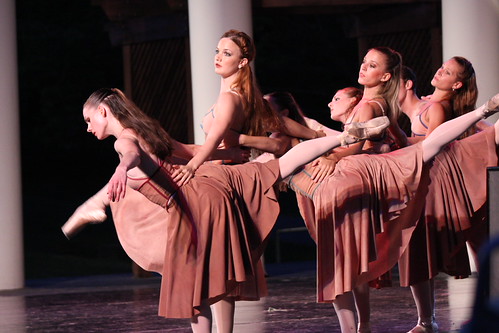
Balletcore translates the ballerina’s off-stage wardrobe into a fashion microtrend, combining athleisure silhouettes with soft fabrics in neutral tones. Balletcore originated in the early 2020s just as the world experienced a global shutdown during the COVID-19 pandemic. Many industries ground to a halt but the proliferation of micro-trends such as balletcore on social media enabled the fashion industry to increase production.
The integration of ballet-like aesthetics into fashion has precedent, but in recent years it is primarily associated with niche luxury designers like Simone Rocha, Sandy Liang and Cecilie Bahnsen (McLaren). Rocha’s Spring/Summer 2021 collection, for example, featured an amalgamation of a ballet flat and a chunky trainer, subverting the associated femininity of ballet with a more masculine silhouette. Liang’s Spring/Summer 2021 collection combined pale-pink tops resembling leotards and square-toed ballet flats. Copenhagen-based designer Bahnsen’s Autumn/Winter 21 collection used draped, relaxed silhouettes to make a clear reference to the rehearsal outfits of the ballerina. Following these precursors, luxury fashion house Miu Miu’s Fall/Winter 2022 collection is generally recognised as bringing ballet aesthetics into mainstream fashion (Newbold). In this collection, femininity is placed at the forefront, through the use of delicate, pink silk as the main material of their ‘Satin Ballerinas’ clothing line. Here, ballet style is not just subtly taken inspiration from but directly copied, offering the model of the ballerina as the ideal, dream woman. Furthermore, Miu Miu’s marketing material for the ‘Satin Ballerinas’ used soft, hazy lighting with low-contrast and pastel colours, mirroring Sofia Coppola’s films and their themes of girlhood, further positioning balletcore as a means to restate and explore femininity.
Balletcore’s ‘point of origin’ in the collections of niche, luxury designers, before moving to more mainstream outlets, is indicative of a traditional fashion trend cycle (Mackinney-Valentin 70). In this cycle, Miu Miu, owned by influential fashion house Prada, sits atop a creative or economic hierarchy (Mackinney-Valentin 70) whereby a style is pioneered and then popularised by celebrity endorsements, or, in the more contemporary age, online influencers. In terms of balletcore, a key celebrity first-adopter of the trend was Bella Hadid, known for her photographed streetwear, who appeared wearing Miu Miu’s ‘Satin Ballerinas’ on social media in the January following the FW22 collection. The trend, pastel tutus, athleisure, legwarmers and ballet flats, quickly cascaded through to fast-fashion online retailers like PrettyLittleThing and Shein, and from there to high-street retailers such as Urban Outfitters and Bershka, the latter part of the Inditex group, whose business mission is clothing that can be designed and produced in as little as two weeks.
Algorithms are central to this fast fashion cascade, identifying and amplifying particular styles and micro-trends (Schulz). At the high-water mark of Balletcore’s popularity on social media platforms such as TikTok, the major retailers leaned in too, with Urban Outfitters producing a number of short online articles describing the trend and how to achieve the look. Whilst this is not a new idea, as Vogue is known to promote brands who pay to be featured in their magazine (Fernandez), it is interesting that now social media producers, fashion publications and retail businesses all work in concert to bring a trend like balletcore to prominence.
Microtrends such as balletcore inevitably have a short shelf-life. By 2025/6, just two to three years since balletcore entered the mainstream, the trend is much diminished. For example, a Google search locates links to balletcore websites and social media promotion from PrettyLittleThing and Urban Outfitters but when clicking through to the actual webpages, they do not exist. Just three years after the trend’s peak all that remains is a 404 Page Not Found notification. Fast fashion retailers and high street stores have moved on but ballerina aesthetics can still be found in the luxury fashion space: in FW25, Salvatore Ferragamo, Rocha and Bahnsen still draw upon ballet as a form of inspiration, donning their models in leotards, tights with satin stirrups, tutus as sleeves and barely-there footwear, illustrating that whilst mainstream fashion might have taken a break from balletcore, luxury fashion still finds it an important point of orientation.
It is important we acknowledge the gender politics of this fashion microtrend. Prior to the emergence of balletcore in the 2010s, streetwear and athleisure dominated popular fashion. This style combined with the ‘not like other girls’ phenomenon of the early 2010s and led to a deemphasising of femininity in mainstream trends. The initial popularisation of balletcore by Rocha, Liang and Bahnsen, and the Miu Miu collection, reintroduces the feminine, acting as a reversal of the more masculine, streetwear look. Commentators argue about the significance of this move. Catherine Rowe-Kosary reads it as giving women an opportunity to reclaim their femininity via an active choice that indicates they have agency. In this argument, femininity is something that can be embraced rather than disavowed and the style is seen as a positive endorsement of the intense discipline expected of a ballerina during her training hours. However, returning to a feminine aesthetic in this way and seeking to emulate the look of the off-duty ballerina, not just through her outfits, but, arguably, through her body – typically extremely thin and white, as Zhiyu Solstice Luo has it – can be seen as a regressive step. If the fashion houses and fast fashion retailers are promoting a style in which a woman must be ultrathin and hyperfeminine there is clearly a risk that women will feel dissatisfied and insecure and thereby subject to wider processes of objectification and self-criticism upon which the fashion industry thrives.
As a microtrend of the early 2020s, the accelerated rise and fall of balletcore typifies the process whereby algorithmic fashion shifts from luxury fashion labels to high-street retailers and back again, even during a time of crisis. This trend tracks a long-running relation between fashion and ballet as a high-cultural form. It registers gender politics through engagements with codings of femininity, where embracing or rejecting the balletcore aesthetic becomes a way of responding to shifts in women’s relations to consumerism, agency and identity.
References
Fernandez, Chantal. ‘Vogue Runway Is Charging Some Brands to Post Their Collection Images.’ The Business of Fashion.com, 12 Jan. 2019. Web. 29 Jun. 2026
Luo, Zhiyu Solstice. ‘Balletcore: A Story of Hyperfemininity, Europeanness, and the Ultra Thin’. Thegazelle.org, Mar. 6 2023. Web. 29 Jun. 2026.
Mackinney-Valentin, Maria. ‘Trend Mechanisms in Contemporary Fashion,’ Design Issues, vol. 29, no. 1, 2013, pp. 67–78. Print.
McLaren, Tamsin. ‘Love the Balletcore Trend? This Is the Fashion History That Inspired It from Chanel to Amy Winehouse.’ Theconversation.com, 12 Aug. 2024. Web. 29 Jun. 2026.
Newbold, Alice. ‘How to Wear the New Balletcore Trend and Stay En Pointe.’ vogue.co.uk, 24 Oct. 2024. Web. 29 Jun. 2026.
Rowe-Kosary, Catherine. ‘Balletcore: Reclaiming Femininity.’ mancunion.com, 24 Oct. 2022. Web. 29 Jun. 2026.
Schulz, Madeleine. ‘How ‘the Algorithm’ Became a Scapegoat for Bland Style.’ vogue.co.uk, 9 Jan. 2025. Web. 29 Jun. 2026.
Tags: 2022, UK, US, fashion
—
This article may be used free of charge. Permission must be obtained before redistribution. Selling or commercial use without prior written consent is prohibited. Copyright @ 2025 Cat Thy Au
Image: ‘Ballet /a practice/’ (2015) by Sara Ristic, Flickr, Licence CC BY 2.0.
This article may be used free of charge. Permission must be obtained before redistribution. Selling or commercial use without prior written consent is prohibited. Copyright @ 2025 Cat Thy Au
Image: ‘Brandy Wine Ballet Company’ (2014) by Jim, the photographer, Flickr, Licence CC BY-NC-SA 2.0; no modification.