

When screenwriters walked off the job in May 2023, artificial intelligence emerged from relative obscurity to become one of Hollywood’s most contentious labour issues. The Writers Guild of America strike, lasting 148 days and affecting over 11,000 writers, concluded with groundbreaking provisions regulating AI use in script development – the first such protections in any creative industry collective bargaining agreement. As generative AI tools demonstrate increasing sophistication in producing text, the screenwriting profession was forced to confront urgent questions about authorship, labour value and technological displacement. Understanding how writers secured protections, and the challenges that remain, offers crucial insights into broader debates about AI’s role in creative work.
Generative AI systems like ChatGPT and Claude can produce screenplay-like content through large language models trained on extensive textual datasets. These tools generate plot outlines, character descriptions and dialogue when given prompts, functioning through pattern recognition rather than genuine narrative understanding. As screenwriter and strike participant Adam Conover told TechCrunch in May 2023, ‘I’m not worried about the technology. I’m worried about the companies using technology, that is not in fact very good, to undermine our working conditions.’ Conover’s concern centred not on AI’s creative capabilities but on economic incentives: studios might generate draft scripts algorithmically and hire writers at reduced rates merely to polish output, transforming screenwriting from authorship into editorial work.
AI became central to strike negotiations with remarkable speed. David A. Goodman, co-chair of the WGA’s negotiation committee, described in a Brookings Institution interview how ‘[i]t was during that negotiation process in the later winter and early spring [2023] that we really started to realise this was something we were going to have to deal with in this negotiation right away […] Suddenly it went from nobody talking about it to everyone talking about it.’ The Guild’s demands prohibited AI-generated material from counting as ‘literary material’ under industry agreements, and this prevented studios from requiring writers to work with AI content. Another key restriction was not to allow the unauthorised use of writers’ work to train AI systems. The strike proved ‘mentally and physically gruelling’ despite strong public support, according to one striking writer quoted by Brookings Institution but after nearly five months of negotiations, the WGA achieved substantial protections in September 2023.
The agreement’s AI provisions establish that AI cannot write or rewrite literary material, cannot serve as source material and that writers retain complete discretion over whether to employ AI tools, with such use not affecting credit or compensation. Crucially, as the WGA’s contract summary states, ‘The WGA reserves the right to assert that exploitation of writers’ material to train AI is prohibited by [the contract] or other law.’ These provisions create industry-wide precedent for regulating AI in creative labour, though enforcement challenges remain as AI capabilities evolve and distinguishing permissible tool use from prohibited generative authorship becomes increasingly complex.
Copyright law’s treatment of AI-generated content compounds these challenges. In March 2023, the US Copyright Office issued guidance confirming that copyright protects only material produced through human creativity, stating that works must be ‘basically one of human authorship, with the computer merely being an assisting instrument’ rather than having ‘traditional elements of authorship […] actually conceived and executed not by man but by a machine.’ In January 2025, the Copyright office released its second report on AI and copyright, reaffirming that ‘human authorship is a bedrock of copyrightability’ and that outputs generated entirely by AI cannot receive copyright protection. This creates significant economic vulnerabilities: studios producing AI generated screenplays face legal risks as competitors could potentially adapt such material without authorisation, though the threshold for sufficient human contribution to achieve copyrightability remains legally contested.
Internationally, screenwriters confront similar anxieties about the impact of AI on their labour. In April 2024, the International Affiliation of Writers Guilds and the Federation of Screenwriters in Europe, together representing approximately 67,000 professional writers across North America, Europe, Israel, South Korea, New Zealand and South Africa, issued joint principles establishing an ethical framework for AI use in scriptwriting. Film festivals focusing on AI-generated work have emerged globally, including the Seoul International AI Film Festival and Korea AI Cinema Festival, demonstrating widespread engagement with these technologies. However, regulatory responses remain fragmented across jurisdictions, creating competitive pressures wherein studios might exploit regions with weaker labour protections or copyright enforcement.
Beyond immediate labour concerns, AI screenwriting raises fundamental questions about narrative creativity and cultural production. Language models predict statistically probable text sequences based on training data; they lack intentionality or cultural embeddedness. As CNBC reported in October 2023, industry observers worry that ‘Hollywood’s AI issues are far from settled’ despite the WGA agreement, particularly regarding copyright uncertainties and whether studios will honour contractual restrictions. The Brookings Institution noted in May 2024 that whilst the WGA’s victory matters significantly for workers facing AI disruption, ‘most workers whose jobs will be disrupted by generative AI will very likely not have the same ability as the Hollywood writers to bargain collectively.’ Considering that only 10 per cent of US workers and 6 per cent of private sector workers have union representation, this certainly seems to be the case.
Power asymmetries amplify these concerns. Major studios possess capital to develop proprietary AI systems and legal resources to navigate intellectual property complexities, whilst individual writers lack equivalent leverage. The WGA agreement covers only union members working under the Minimum Basic Agreement; screenwriters in non-unionised contexts, independent productions, or international markets lack equivalent safeguards. Moreover, as TechCrunch observed, ‘It’s yet to be determined how the contract for SAG-AFTRA members will pan out, but the WGA’s agreement sets a precedent for establishing limitations against how AI can be used in creative professions,’ indicating ongoing struggles across entertainment sectors.
The 2023 WGA contract represents significant but incomplete protection. Longer-term challenges involve developing regulatory frameworks balancing technological innovation with labour rights and cultural diversity. This may necessitate legislative intervention establishing clear authorship standards, mandatory AI disclosure requirements, and restrictions on training systems with copyrighted material absent licensing agreements. International coordination could establish baselines standards preventing regulatory arbitrage, though achieving consensus across jurisdictions with divergent intellectual property traditions and labour protections poses substantial diplomatic challenges.
Ultimately, debates surrounding AI and screenwriting concern power rather than technology: who controls cultural production, who benefits from automation and whose creative labour merits protection and fair compensation. The WGA strike demonstrates that collective action could establish boundaries constraining AI deployment, establishing what one legal analysis termed ‘groundbreaking AI protections’ that could be even harder’ for actors and other creative workers to achieve (Fordham Journal of Corporate and Financial Law).
For screenwriting to remain a viable profession producing culturally meaningful work, the industry must resist framing such technological transformation as inevitable. The alternative, a future wherein algorithmic tools generate formulaic content whilst human writers face precarity, would impoverish not only the profession but culture itself.
References
Brookings Institution. ‘Hollywood Writers Went on Strike to Protect Their Livelihoods from Generative AI. Their Remarkable Victory Matters for All Workers.’ 23 May 2024. Brookings.edu. Web. 24 May 2026.
CNBC. ‘Hollywood’s AI Issues Are Far from Settled After Writers’ Labor Deal with Studios.’ 17 Oct. 2023. Cnbc.com. Web. 24 May 2026.
Fordham Journal of Corporate and Financial Law. ‘Writers’ Guild of America (WGA) Strike Resolution: AI Restrictions and Implications.’ 25 Oct. 2023. News.law.fordham.edu. Web. 24 May 2026.
TechCrunch. ‘The Writers’ Strike is Over; Here’s How AI Negotiations Shook Out.’ 26 Sept. 2023. Techcrunch.com. Web. 24 May 2026.
US Copyright Office. ‘Copyright and Artificial Intelligence, Part 2: Copyrightability.’ 29 Jan. 2025. Copyright.gov. Web. 24 May 2026.
US Copyright Office. ‘Copyright Registration Guidance: Works Containing Material Generated by Artificial Intelligence.’ 16 Mar. 2023. Copyright.gov. Web. 24 May 2026.
Variety. ‘How the WGA Decided to Harness Artificial Intelligence.’ 25 May 2023. Variety.com. Web. 24 May 2026.
Writers Guild of America. ‘Artificial Intelligence.’ 18 Dec. 2025. wgacontract2023.org. Web. 24 May 2026.
Writers Guild of America. ‘Memorandum of Agreement for the 2023 WGA Theatrical and Television Basic Agreement’. wgacontract2023.org. 25 Sept. 2023. Web. 24 May 2026.
Tags: US, artificial intelligence, screenwriting, film, industry
—
This article may be used free of charge. Permission must be obtained before redistribution. Selling or commercial use without prior written consent is prohibited. Copyright @ 2025 Taheya Sardar
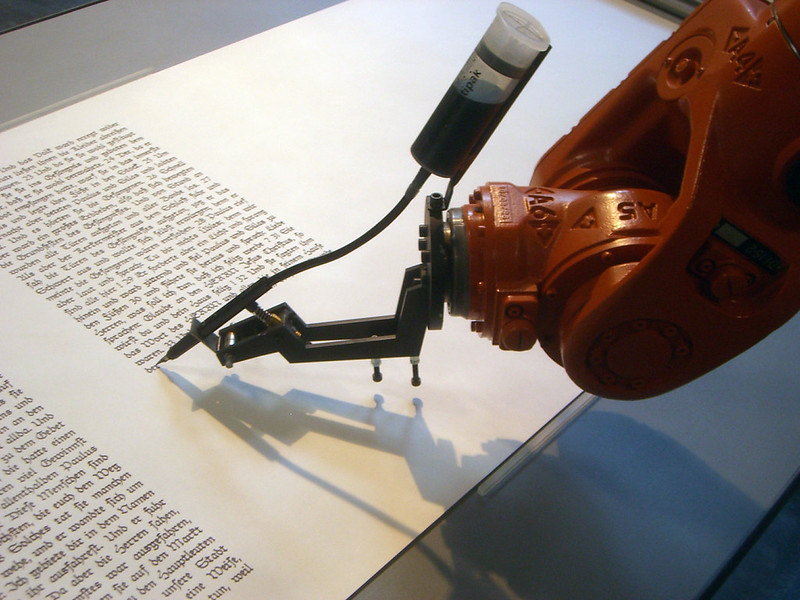
Images: ‘bios [bible]’ (2008) by Mirko Tobias Schäfer, Flickr, Licence CC BY 2.0.