
Dark and the time-image, written by Elinor Holly Jenkins
Created by Baran bo Odar and Jantje Friese, Dark (Season 1, 2017) is the first Netflix series entirely in the German language. The series brings together the investigation of a number of child murders, cover ups of accidents at a nuclear plant, and a complex time travel narrative structure. According to Greg Peters, Netflix’s Chief Product Officer, it is one of the most popular non-English language series on Netflix, with over 90 per cent of its viewers from outside Germany (qtd. in Roettgers; see also Rogers). The series has received critical acclaim both nationally and internationally, receiving a Grimme-Preis award for fiction in 2018, as well as several other nominations, including in the Goldene Kamera 2018 television awards.
Dark subverts the conventional linear narrative structure used across film and television in ways that resonate with Giles Deleuze’s concept of the ‘time-image’ (26). Deleuze claims that World War II is a significant turning point in the representation of time in cinema. This is due to the catastrophic global impact of the war but also the ways in which: ‘the post-war period has greatly increased the situations which we no longer know how to react to’ (xi). Deleuze argues that faith was lost in the movement-image of classical narrative, replaced by a questioning of the function of memory and control as a result of the experience of the Holocaust, widespread civilian bombing campaigns, and the loss of millions of lives. In cinema, this results in the time-image. Deleuze argues that in film, time has historically been represented as subordinate to action and movement, and the time-image represents a subversion of this: ‘[i]t is this reversal which means that time is no longer the measure of movement but movement is the perspective of time’ (22).
Dark’s non-linearity and engagement with the concept of time exemplify Deleuze’s time-image. Time exists independently of the characters and is capable of controlling them: no matter how much they try to change the course of events, they seem paralysed and unable to act. This reflects Deleuze’s assertion that the time-image uses time to examine uncertainty, reflected through moments of immobility, reverie, or paralysis; thereby subverting the importance of action in the movement-image (36). When Jonas (Louis Hofman) is locked in the cellar by his older self, he is figuratively and literally immobile, unable to act because he has been imprisoned by a version of himself that he does not yet understand.
Deleuze explores the concept of the ‘crystal-image’ as an important component of the cinematic time-image. Through this concept he explores the split of the real and virtual through representations of present and past. In the passing of each moment he describes the process of the actual (real) present becoming the imaginary (virtual) past through memory. He explores the aesthetic of this by using the analogy of mirror images as an example of how actual and virtual become ‘[d]istinct, but indiscernible’ through their ‘continual exchange’(70). Dark exemplifies Deleuze’s concept of the crystal-image through its narrative and aesthetic. Real and virtual are indiscernible and exist simultaneously through characters’ memories, and through the element of time travel in which distinctions between past, present, and future are made arbitrary. At times it is unclear whether we are being shown the real present or virtual past. It is this indiscernibility which makes Dark so evocative of the time-image. This is explored through the paradoxical nature of time travel which Jonas is faced with. By saving Mikkel in 1986, he would not become Michael, and Jonas would never be born. In this sense Dark, following Deleuze’s analysis, presents ‘undecidable alternatives and inexplicable differences between true and false’ (132) as Jonas must choose between his own life and the life of his father.
The distorted mirrored images of bodies in the series’ title sequence (designed by Lutz Lemke) engages with the concept of the crystal-image through its representations of symmetry and kaleidoscopic patterns. In symmetry, real and virtual become indiscernible, reflecting the Deleuzian crystalline narration of the series itself. As Deleuze writes, ‘[s]ensory-motor situations have given way to pure optical and sound situations to which characters, who have become seers, cannot or will not react, so great is their need to ‘see’ properly what there is in the situation’ (133). This concept is developed throughout the series, as the narrative is driven by the desire to uncover the mystery. The recurring images of eyes in the title sequence reflect this and can be interpreted as an example of Deleuze’s suggestion of characters as seers. The title sequence also establishes the main locations of the series: the caves, woodland, roads, and nuclear plant. The distortion of these images in the title sequence suggests illusion and conspiracy: things are not as they appear. It also lends a timelessness to the sequence, as it is not clear in which time period the locations and bodies are being shown. The symmetry effect also references the time loop, representing characters and locations mirrored in different moments in time. This is another instance of Dark demonstrating the complex and ambiguous relation between time and space: firmly establishing itself as time-image.
The title sequence also evokes the theme of interconnectivity in the series through splitting and merging images. In episode eight, H.G. Trannhaus (Axel Werner) says that ‘our thinking is shaped by dualism’. He argues this is wrong and explores a third dimension represented by the triquetra: future, present, and past. Through this statement of philosophy Dark challenges conventional duality and chimes with Deleuzian concepts of splitting time into ‘two dissymmetrical jets, one of which makes the present pass on, while the other preserves all the past’ (81). It is this quality of splitting that Deleuze argues constitutes the crystal-image. The title sequence, therefore, represents the nexus between time periods and different families in the series. The mirror effect can be interpreted as past and present existing simultaneously as crystal-image. The rotation of images, and hints of clockwork in the title sequence are also evocative of the labyrinthine conception of time which Dark presents: everything is connected, as the series’ tagline has it.
This connectedness is maintained through the theme of determinism in Dark. It deals with complex philosophical ideas through its exploration of time travel. In classical (movement-image) cinema characters act in order to change their circumstances; however Dark as time-image challenges this concept of free-will. We continuously see characters destined to repeat the same actions again and again in a self-contained cycle (ultimately leading to the apocalypse at the end of season one). Every action made to break the cycle only reinforces their past and future situation further This demonstrates how movement is represented as subordinate to time. Characters who act in order to change the past inevitably only allow it to happen. In episode eight Ulrich (Oliver Masucci) tries to kill child Helge (Tom Phillip) in 1953 to prevent his future role in the kidnap and murder of the children. However, Helge survives, and we discover Ulrich’s responsibility for the scarring and deformity of his face and ear. Old Helge also travels from 2019 to 1986 to convince his younger self to act differently. In an attempt to prevent his past actions by causing a car crash, 40-year-old Helge survives, while his older self is killed (episode ten). Dark is therefore demonstrating how even the most dramatic attempts to break the cycle inevitably maintain its course. This is also reflected through Jonas’ attempt to close the time-loop, which Noah claims is actually the cause of its creation in the first place.
In each case, characters are unable to act to change their (past, present, and future) circumstances, therefore subverting the conventional function of causality in classical cinema. Dark often reflects this atmosphere through images of characters from different eras side by side or fading into each other. In each case the character stares directly at the camera, immobile, as if in reverie. This is a visualisation of their function as observers, trapped in the endlessly repeating cycle of the time-image: a further representation of Deleuze’s lack of control.
References
Deleuze, Gilles. Cinema II: The Time-Image. Trans. Hugh Tomlinson, Robert Galeta. Minneapolis: University of Minnesota Press, 1989. Print.
Roettgers, Janko. “Netflix’s Drama Dark May Be From Germany, But 90% of its Viewers Are Not”. Variety.com. 6 Mar. 2018. Web. 20 Dec. 2019.
Rogers, Thomas. “With Dark, A German Netflix Series, Streaming Crosses a New Border”. New York Times.com. 23 Nov. 2017. Web. 20 Dec. 2019.
Tags: 2017, US, television, cinema, digital media, industry, Netflix, fantasy
—
This article may be used free of charge. Permission must be obtained before redistribution. Selling or commercial use without prior written consent is prohibited. Copyright © 2022Elinor Holly Jenkins
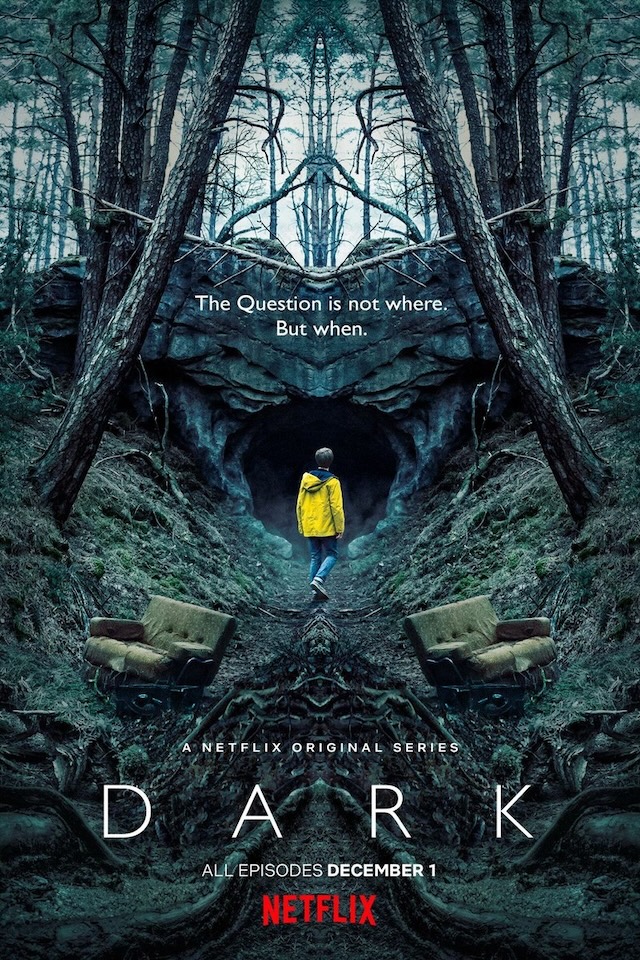
Image: a low resolution widely available promotional poster used in accordance with UK fair dealing for non-profit and educational use