

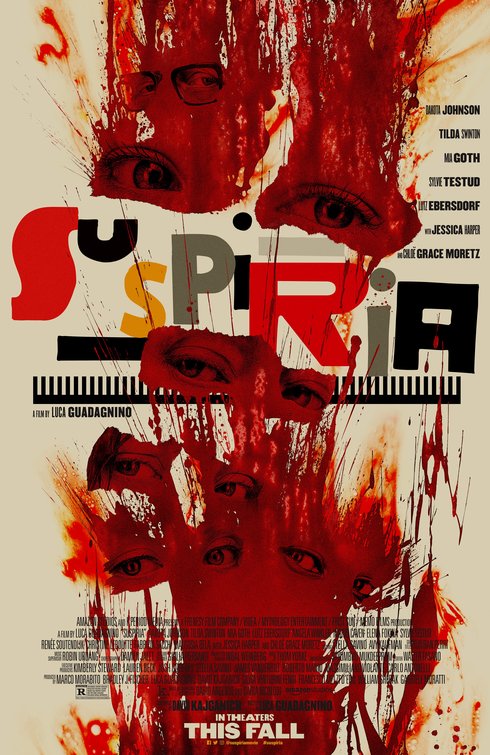
Suspiria and the Reinvention of the Witch
Luca Guadagnino’s Suspiria (2018) is a remake of Dario Argento’s cult thriller of the same name, part homage, part reinvention, the film reclaims the witch archetype as a site of female power.
In her essay Power of Horror (1982) Julia Kristeva use the term ‘abject’ to refers to literary depictions of bodily fluids such as blood, pus, and sweat, as well as visual signifiers of death and decay, such as corpses and bodily parts, explaining that such images cause abjection as they reveal the permeable physicality of the human body, thus alluding to its mortality. Kristeva’s essay on the abject in horror literature, was later used by Barbara Creed, to explore cinematic horror. In her book The Monstrous Feminine (1993), Creed utilizes Kristeva’s descriptions of the ‘abject’, as well as Freudian psychoanalytic theory, in order to demonstrate the tropes used in the horror genre to depict woman as monstrous, ascribing the monstrous female’s abject nature to her ability to castrate either literally or metaphorically. Creed explicitly refers to the witch archetype, explaining that one of the prominent features of the witch ‘in earlier centuries was her role as healer’ (74), a positive role which was however removed from contemporary portrayals, after the prevalence of the witch figure in ‘the 1960s [when she] joined the ranks of popular horror film monsters’ (73). In Creed’s words the witch figure was usually depicted as an ‘old, ugly crone’ (72) ‘represented within patriarchal discourses as an implacable enemy of the symbolic order’ (76), who needed to be expelled as part of films’ moral restoration. Discussing Suspiria (1977) Creed elaborates on the film’s stereotypical representation of Mother Suspiriorum, as ‘a grotesque, monstrous, completely hideous figure’ (76), and critiques the film’s lack of exploration of the witches’ purpose, making them appear as existing with the ‘sole purpose […] to wreak havoc and destruction in the world’ (76).
Guadagnino’s adopts a similar narrative spine to Suspiria (1977) as well as some of the stereotyping that Creed is critical of. For example, in one sequence three witches in the coven hypnotize two police officers and laugh at them while the latter are unable to react. Having removed one of the officers’ trousers and underwear, the three witches are seen playing with his naked body, placing a pen, a meat-hook, and a gun next to his genitals, as if ready to castrate him. The women’s deafening laugh as they torment the police officer reinforces stereotypical representations of the witch as a castrating woman whose main purpose is to cause ‘male impotence’ (Creed, 75). Furthermore, Helena Markos (Tilda Swinton), as the embodiment of the film’s evil, is given the most stereotypical representation. The first time she is present in the film, we are only allowed to see her hand touching the ceiling, above which Susie is dancing. Wrinkled and full of blisters, her hand, together with her long, neglected nails, and the sound of her coarse breathing, convey a repulsive image of a living corpse. The abjectness of Helena Markos is further highlighted in the climactic sequence of the film during the Mutterhaus ritual. In this sequence, the entirety of Markos’ body is visible, revealing a figure that looks less like a human body, and more like a decaying mass of flesh. During the sequence her speech is slow and laboured, as if underdeveloped, and often instead of expressing meaning through human speech, she produces sounds, shrieking, hissing and whimpering, signifying, as per Creed, ‘a collapse of the boundaries between human and animal’ (10).
However, Suspiria (2018) subverts the original film by adding complexity. It is revealed that Susie (Dakota Johnson), previously a final-girl, is now Mother Suspiriorum, able to dethrone Helena Markos, and assert her dominance over the coven. Presented as a witch herself, Susie evidently demonstrates elements of the abject throughout the film. Her abjectness is vividly shown in the sequence when she auditions for Olga’s part, while Olga is trapped in the academy’s basement. After Madam Blanc casts a spell on Susie, the latter becomes able to control Olga’s body, breaking her bones and tendons with every movement she makes. After the end of the dance Olga’s body is folded in two, covered in blood, saliva and urine. Susie’s abject effect on Olga’s body might not be consciously induced, but it reveals her violent power and ability to cause lethal harm. Furthermore, in the climactic scene of the Mutterhaus ritual, Susie summons death and kills Markos and her supporters. During the scene Susie’s abjectness becomes evident, as her command ‘Death to any other mother’ causes Markos to vomit blood, before slowly dying, and Markos followers’ bodies to violently explode. While the scene’s violence is undeniable, it would be hard to read Susie’s action as a ‘destruction of the [male] symbolic order’ (Creed, 76), as the impact of Markos throughout the film was associated with division within the academy. Thus, one could argue that through the extermination of Markos and her followers, Susie restores social order and expels elements of deception and manipulation from the academy. Furthermore, the film’s climactic sequence reveals another trait of Susie, namely her ability to redeem, opposing the trope that the witch ‘is an inversion of the good woman’ (Young, 154). After killing Markos and her followers, Susie approaches Olga, Patricia, and Sara asking them one by one what they wish. The girls all wish death, and Susie kisses them with tenderness causing them to die peacefully, in contrast to Markos and her followers’ cruel deaths. In a later scene, Susie visits Klemperer and after revealing to him what truly happened to his wife, she erases his memory, as a way to relieve him from his guilt. Susie’s simultaneous ability to provoke violence and death, associating her with the abject, as well as restore balance and relieve pain, which could be read as a form of maternal healing, subvert the stereotypical tropes of witch representation, ultimately suggesting that ‘it is possible to have a relation to abjection while at the same time being a […] unifying force’ (Davies, 52).
In the end, the film refrains to juxtapose the abject ‘Markocite’ —as used by Klemperer to describe Markos and her followers— figures against their polar opposite, namely an entirely virtuous witch figure. Instead, it allows for the exploration of a similarly abject figure, Susie, who is nonetheless able to restore balance, and occasionally behave as an ‘upholder of morality’ (Young, 154). The film’s ability to renounce the archetypal binary of ‘bad’ castrating witch, and ‘good’ nurturing witch, allows for a rare exploration of monstrous femininity as a multi-dimensional condition, able to define itself reflectively and dynamically.
References
Creed, Barbara. The Monstrous-Feminine, Film, Feminism, Psychoanalysis. Oxford: Routledge, 1993. Print.
Davies, Luke. “Appropriating the Abject: Witchcraft in Dario Argento and Daria Nicolodi’s Suspiria (1977) and David Kajganich and Luca Guadagnino’s 2018 Remake.” New Cinemas, 18 (2020): 43-59. Print.
Kristeva, Julia. Powers of Horror, An Essay on Abjection. New York: Columbia University Press, 1982. Print.
Young, Serinity. Women Who Fly: Goddesses, Witches, Mystics, and other Airborne Females. Oxford: Oxford University Press, 2018. Print.
Tags: 2022, US, cinema, horror
—
This article may be used free of charge. Permission must be obtained before redistribution. Selling or commercial use without prior written consent is prohibited. Copyright © 2022 Maria Nephele Navrozidi
Image: a low resolution widely available poster used in accordance with UK fair dealing for non-profit and educational use