

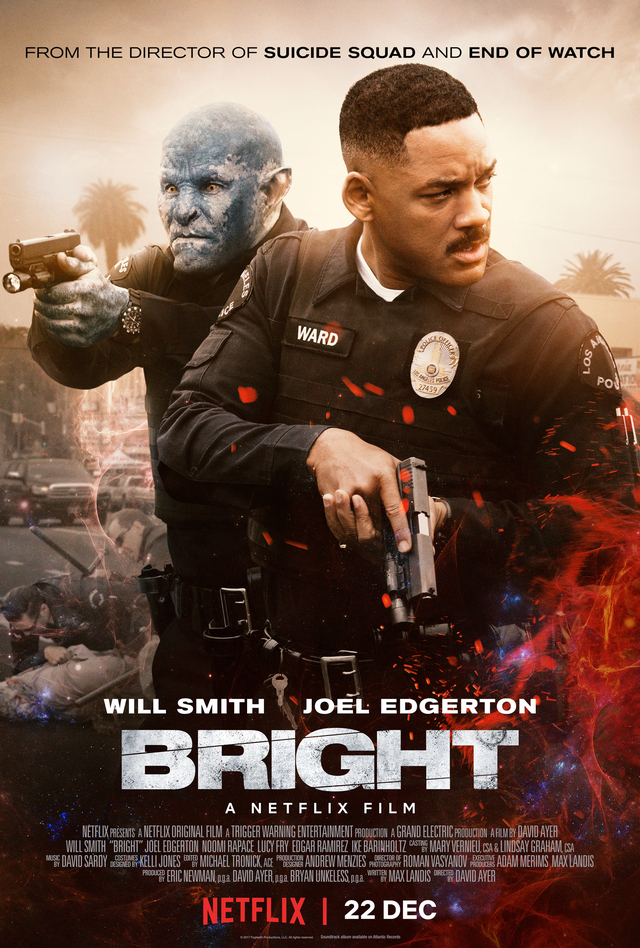
Bright and the Netflix Blockbuster
Receiving a Rotten Tomatoes score of 26 per cent Netflix’s first tent-pole film Bright (2017), was a critical disaster. IndieWire even claimed it was “the worst film of 2017” (Ehrlich). Nevertheless, Bright remains one of the most important films of the contemporary moment as it demonstrates that Netflix is now funding big-budget blockbusters. Coupled with Netflix’s long tail economic model and its use of algorithms and ‘Big Data’, Bright represents a significant challenge to the ‘Big Six’ media conglomerates thereby amplifying claims that the company is moving audiences away from the box office and towards their streaming service.
From an industrial standpoint, Bright represents two core ideas: it challenges the perception of the kinds of films Netflix can produce in terms of scale while also furthering the case for the Netflix distribution model against the more traditional box office release. Since its first attempt at feature film production in 2015 Netflix has been increasing its yearly output of films. In 2016, the company produced eighteen films, an annual number which rose to 41 in 2017. While a handful of these films were critically lauded – Okja (2017) and The Meyerowitz Stories (New and Selected) (2017) were both screened at Cannes Film festival – up until Bright, none could be categorised as major blockbusters in terms of budget, scale and mass appeal. As a result, many industry executives downplayed the threat of Netflix. For instance, James McQuivey at Forrest Research claimed: ‘Despite Amazon’s (and Netflix’s) success with TV shows, it’s very unlikely they’re going to have a blockbuster movie on their hands […] A nice niche picture, maybe. In the horror genre, easily; or perhaps something edgy and artsy, but not the kind of movie that’s going to run two months in theaters [sic]’ (qtd. in Lang and Graser). However, from the very moment Bright’s opening credits roll and audiences witness blue ‘magic’ emanating from behind the Netflix logo (the company usually leaves this production title standardised for all its content) it is clear this is a different kind of Netflix film.
To start, Netflix defeated Sony and Warner in a bidding war and provided Bright with a reported $90m budget (Dyer), making it their most expensive film to date. They also secured the services of David Ayer and Will Smith who have both proven their worth commercially – Ayer directed Suicide Squad (2016) the year before which grossed over $746m worldwide while ‘in the years they are released, Smith’s films [have] consistently ranked amongst the top ten grossing titles at the domestic box office’ (McDonald 2012). Furthermore, unlike Netflix’s previous films, Bright is predominately driven by action and large expensive set pieces such as the scene in a petrol station where a car is driven through a building and bodies are thrown dramatically through the air culminating in a dramatic explosion.
However, despite these efforts, critics such as Ryan Lambie criticised Bright’s production quality, claiming: ‘Bright looks noticeably ramshackle in places – Netflix may want to beat Hollywood at its own game with this edgy and violent thriller, but its production values barely exceed a typical episode of, say, a Marvel TV show.’ This criticism may be down to the association of Netflix with television but also because Bright’s budget was still less than half of a typical blockbuster franchise such as a Marvel or Star Wars film, which averages at approximately $200m. Consequently, focusing on a world that resembles modern day LA may have been an economic as well as creative decision as it requires less expensive CGI and set building.
However, Netflix executives defended the film with CEO Reed Hastings claiming, ‘the critics are pretty disconnected from the mass appeal’ (qtd. in Wallenstein). Hastings’ claims seem justified as Bright achieved an audience score of 86 per cent on Rotten Tomatoes. Furthermore, Nielson’s estimate suggest that Bright received more than 11 million views in its first three days of release (Spangler). Using the average cinema ticket price, Spangler roughly calculates this equates to a $100m box-office opening weekend for Bright, which is roughly equal to the domestic box office gross for Wonder Woman (2017). While Netflix refuses to disclose official statistics, the company argues that Nielson underestimates viewer numbers as it does not consider international views or those on mobile devices and computers.
However, rather than a theatrical release, Bright operates by a different set of rules as Netflix’s economic model relies on monthly subscriptions rather than theatrical release and ticket sales, thereby functioning as an example of long tail economics. As summarised by Kevin McDonald, this model makes it ‘possible to build a profitable business on the low but steady demand for a wider range of inventory as opposed to the fleeting but large-scale demand for the most popular goods’. Therefore, rather than risking $200m budgets on precarious box-office releases, Netflix can rely on a low but steady income of monthly subscriptions while focusing on the long-term life of a film and the wider ecology of its archive. In addition, due to Netflix’s rigorous algorithmic analysis of its subscribers’ viewing habits and tastes, it can target prospective viewers indefinitely. Bishop observes how ‘mentions of the film will pop up in the browsing experience of users that the service has determined are most likely to respond to the film’s mix of gritty action and magical fantasy […] Someone who watches a lot of fantasy shows might get a Bright thumbnail that features Lucy Fry’s elf character, for example, while fans of director David Ayer may see one emphasizing Smith and Edgerton’s characters in their LAPD uniforms.’ This targeted and personalised advertising not only increases the number of viewers but also drives down the marketing budget as Netflix can spend less on expensive television slots or billboards, consequently allowing them to invest more in production. The reality is less about ‘mass appeal’ than algorithmically-targeted appeal.
Although differentiated from Hollywood studios in terms of its distribution platform and economic model, Bright mimics many of the same synergistic techniques used by contemporary Hollywood, especially its use of narrative world building and transmedia storytelling. As Henry Jenkins claims, in Hollywood ‘storytelling has become the art of world-building, as artists create compelling environments that cannot be fully explored or exhausted within a single work’ (114). Bright mimics this method as throughout the film it alludes to a larger world that extends beyond the singular film. For instance, at the beginning of the film, we are presented with a quote from ‘The Great Prophecy 7:15’. We do not know where the prophecy is from and its provenance is not revealed. Similarly, the first sequence of the film introduces the narrative world through graffiti art and murals while characters allude towards a rich history where the ‘Dark Lord’ reigned only to be defeated by the ‘nine armies’ lead by an orc called Jirak some 2000 years earlier. Similarly, other details such as the ‘Shield of Light’ and mythical creatures such as dragons and centaurs are teased to set up a universe that could be explored in sequels.
In addition to setting up a story to span across multiple film sequels, Bright’s world also spreads across media. Jenkins describes how a transmedia story world such as this is indicative of convergence culture where media flow across multiple platforms due to the alliance between large corporations with diverse interests (2). In addition to converging with the television and internet industry through Netflix, Bright also extends to the music industry as not only did the company commission a soundtrack featuring popular artists such as Machine Gun Kelly, A$AP Rocky and alt-J (which audiences can buy or stream in the form of an album thereby creating extra revenue) Netflix also produced music videos for four of the commissioned songs prior to the film’s release.
Ultimately, Bright is an example of Netflix challenging the rules of production, consumption and distribution of a typical theatrically released film while simultaneously borrowing the corporate and narrative techniques of contemporary Hollywood. Bright demonstrates to audiences that Netflix can produce the kinds of big blockbusters they are used to watching in cinemas but in a way that is more convenient (audiences can watch the film in the comfort of their own home or on mobile devices) and cheaper (in the UK a Netflix monthly subscription is less than the price of a single cinema ticket).
References
Bishop, Bryan. ‘How Netflix is trying to rewrite movie marketing with Bright’. The verve.com. 19 Dec. 2017. Web. 4 Apr. 2018.
Dyer, James. ‘Bright Review’. empireonline.com. 20 Dec. 2017. Web. 4 Apr. 2018.
Ehrlich, David. ‘Bright Review: Netflix’s First Blockbuster Is the Worst Movie of 2017’. indiewire.com. 10 Dec. 2017. Web. 4 Apr. 2018.
Jenkins, Henry. Convergence Culture: Where Old and New Media Collide. New York: New York University Press, 2008.
Lambie, Ryan. ‘Bright Review’. denofgeek.com. 22 Dec. 2017. Web. 4 Apr. 2018.
Lang, Brent and Marc Graser. ‘Amazon Movies May Crack Theatrical Windows, But It Won’t Break Them’. variety.com. 19 Jan. 2015. Web. 4 Apr. 2018.
McDonald, Kevin. ‘Digital Dreams in a Material World: The Rise of Netflix and Its Impact on Changing Distribution and Exhibition Patterns’, Jump Cut. n.d. Web. 4 Apr. 2018.
McDonald, Paul. Hollywood Stardom. Chichester: Wiley-Blackwell, 2012. Print.
Ndalianis, Angela. Neo-Baroque Aesthetics and Contemporary Entertainment. Cambridge, Mass: MIT Press, 2004. Print.
Spangler, Todd. ‘Netflix’s Bright Lands 11 Million US Streaming Viewers Over First Three Days’, variety.com. 28 Dec. 2017. Web. 4 Apr. 2018.
Wallenstein, Andrew. ‘Netflix Execs Call Critics ‘Disconnected’ for Bashing Bright Film’. variety.com. 22 Jan. 2018. Web. 4 Apr. 2018.
Tags: 2017, US, television, cinema, digital media, industry, Netflix, fantasy
—
This article may be used free of charge. Permission must be obtained before redistribution. Selling or commercial use without prior written consent is prohibited. Copyright © 2018 Hansel Rodrigues.
Image: a low resolution widely available poster used in accordance with UK fair dealing for non-profit and educational use