

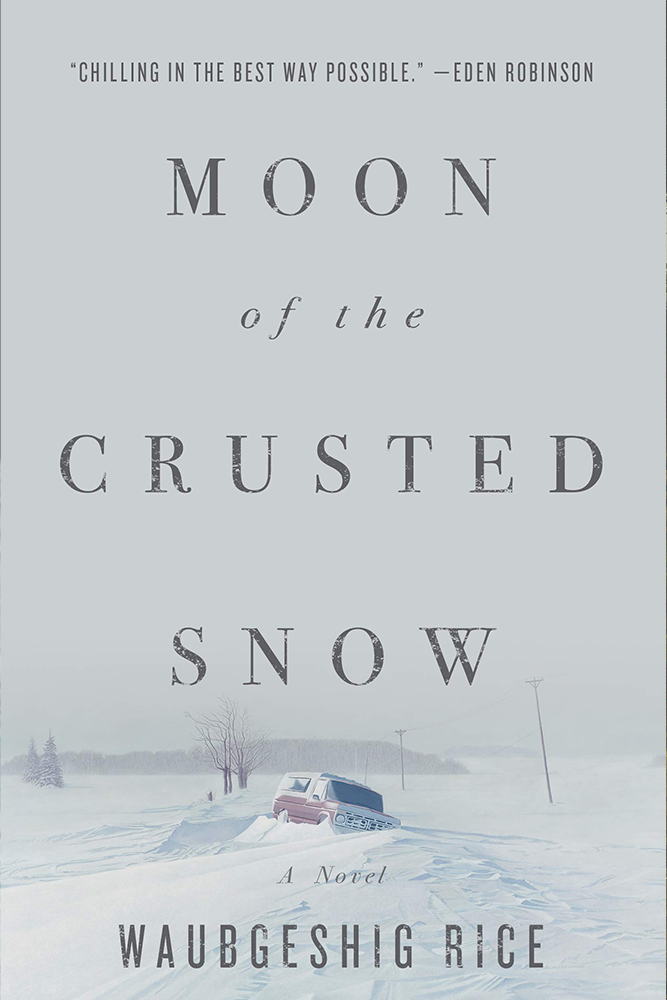
Moon of the Crusted Snow and settler colonialism
Waubgeshig Rice’s Moon of the Crusted Snow (2018) is a post-apocalyptic novel about an Anishinaabe community in Northern Canada who must confront a harsh winter and sudden power outage. Oftentimes, post-apocalyptic novels focus on large infrastructure collapses leading to mayhem, with one or two strong individuals centring the story. However, Rice departs from this conventional narrative by telling the story in a different way – not one of individual survival, but of community preservation. His novel reveals the violence of settler colonialism and emphasizes that, for Indigenous communities, the effects of settler colonialism are not speculative, but rather an ongoing, lived reality.
Understanding settler colonialism is essential to understanding Rice’s novel. Settler colonialism is the displacement of native people from their land in favour of colonial development. The repercussions of settler colonialism far outlive the actual act of invasion, as it undermines Indigenous ways of life by replacing them with capitalist systems that focus on expansion and exploitation of the land.
The novel begins with Evan White Sky killing a moose for food. No expository anchors for setting, location or date are provided. However, we are told that ‘the fall hunt was drawing to a close’ (3). The ‘fall hunt’ implies a self-sustaining mode of living and a degree of isolation, challenging colonial modes of consumption. Because Evan’s spatial and temporal understandings are rooted in natural and cultural rhythms, the reader is required to navigate the narrative through this perspective.
Mark Rifkin’s analysis of Indigenous temporality usefully frames the book’s loose sense of time and space as a way of engaging with settler colonialism. Rifkin writes that for many indigenous communities there is no singular, unified version of time, but instead various time formations that ‘have their own rhythms, patterns of consistency and transformation that emerge immanently out of the multifaceted and shifting sets of relationships that constitute those formations’ (2017). The ‘present’ that Evan and the rest of the Anishinaabe community experience differs from the ‘present’ that the rest of ‘the South’ face. Evan’s actions, if performed elsewhere, might be interpreted as archaic or violent. However, the timeline Evan occupies allows his actions to reflect his necessary and sustainable intentions within its own context. This positions the reader in a place such that non-Indigenous language, actions or traditions become alien, to the point that when this narrative flow is later interrupted, it disorients us as readers even more.
The only character to provide modern definitions of time throughout the novel is Justin Scott, who symbolises white, heroic masculinity and the settler colonial mindset. Rice emphasizes the dissonance of Scott’s presence through narrative defamiliarization; when Scott arrives at the community several days after the power outage, he immediately offers a concrete indicator of time, stating that ‘ten days’ have passed (103). This is the first disruption of the Indigenous temporal framework in the novel. Scott’s perception of time feels unnatural within the story’s established setting and rhythm, because he imposes a worldview that feels starkly different from Evan’s relational orientation to time and the land.
Scott’s initial friendliness plays a crucial role in exemplifying the manipulative nature of settler colonialism. He uses overly friendly terms with the Anishinaabe, such as ‘brother’, ‘son’ and ‘friend’ in an attempt to disarm suspicion. When questioned on his ability to integrate with the hunters, he replies ‘I’m a bit of an outdoorsman myself. I think I’ll fit in well here’ (103). Scott’s character represents the European presence in native spaces – uninvited and presumptuous, acting only with self-preservation in mind.
Evan intuitively understands Scott’s presence as intrusive, feeling as though Scott is ‘coming right for [him]’ (99). Grace Dillon writes that the relationship of colonialism and conquest ‘often borrows imagery of the frontier of howling wilderness’ because ‘you were not certain they existed until they came’ (220). When three new arrivals attempt to seek refuge in the community, Scott asserts control by pointing a gun at them and ordering, “if you want to come in here, it’s on our terms” (141). His use of ‘our’ shows his inherent disregard for his own position as an outsider. Thus, he reflects colonial settler dynamics, not only through occupying Indigenous space, but also by assuming governance over their community.
Rice also uses infrastructure to explore settler colonialism in the novel. While the Anishinaabe have access to modern infrastructure such as cell phone towers, it is only because ‘the construction contractors from the South wanted a good signal while they built the massive new hydro dam’ (Rice 14). Rice uses the Nanabush story, which teaches the relevance of self-preservation, to represent those in the community who are culturally disconnected because of their reliance on outside infrastructure. The story follows the Nanabush as he tries to find food before winter. Instead of only taking what food he needs, he kills 30 geese and employs his bum to protect the geese while he sleeps. When his bum inevitably fails, he attempts to punish it by burning it – in turn punishing himself. Cam, Evan’s brother, is an example of this Nanabush character. Despite the community relying on generators, Cam does not conserve energy and justifies playing video games and hosting parties by saying he is ‘Just survivin’ bro’ and ‘needed a night off’ (130-131). He displays strong individualistic attitudes and takes warmly to Scott’s arrival, unlike his brother, and, like the colonisers, he is only able to invest in what serves his self-interest. Cam represents how people can become easily influenced when they are disconnected from their roots—he is not acting in the interest of his community or his family.
Gerald Vizenor discusses this disconnect from traditional values by relating Indigenous representation in dominant cultural narratives to the term ‘survivance’ (16). Survivance describes the continuous presence of Indigenous people outside of mere survival. In literature, this manifests often via descriptions of traces of accurate native culture and history embedded in the experiences of characters living under settler occupation. It is exhibited in Rice’s use of dreams in the novel. Typically, dreams serve as an expression of desires, fear or imagination in literature; however, Rice employs dreams not merely as a device for foreshadowing, but also as a deeper expression of Indigenous knowledge and consciousness. For example, when Evan’s father, Dan, recalls his dream, he establishes his environment through instinctual knowledge: ‘it was springtime. I dunno how I could tell, because it was so dark, but I just knew that it was’ (25). He further recounts ‘we had to put the burn on to try and get some moose in. I can’t remember the last time we had to do that around here’ (Rice 26). Dan’s intuitive awareness of their impending hardship reflects not only his personal fears but also a collective memory of struggles with scarcity. His reality is shaped by the long history of indigenous life and settler colonial disruption.
Rice uses this dream to establish two key ideas: firstly, the Anishinaabe people have historically endured long hardships of survival, and secondly, despite this, they have managed to persevere and survive. This theme is also explored later in the novel, when Evan talks to Aileen, one of the community elders, who eases his worries by reaffirming ‘she’s lived through it all’ (57). Vizenor discusses this tragic wisdom in Indigenous people, stating, ‘native resistance of dominance, however serious, evasive and ironic, is an undeniable trace of presence over absence, nihility and victimry’ (17). Rice uses dream sequences to display survivance, that is, the persistence of intuitive cultural knowledge in resistance to colonial erasure.
The novel avoids resolving the external plot, ending without determining what caused the power outage. By withholding an explanation, Rice continues to resist settler colonial narratives. Despite the apocalyptic event that is occurring (not the first for Indigenous people) survivance relies on continuation of life and the preservation of their history. The gradual progression of the apocalyptic events symbolises the slow overtaking (in waves) of Indigenous land by colonisers. Rice’s novel, and its refusal or conventional narrative form and temporality in favour of dreams, tradition and survivance, highlights an ongoing process of Indigenous resistance.
References
Dillon, Grace. ‘Miindiwag and Indigenous Diaspora: Eden Robinson’s and Celu Amberstone’s Forays into ‘Postcolonial’ Science Fiction and Fantasy.’ Extrapolation, vol. 48, 2007, pp.219-256. Print.
Rice, Waubgeshig. Moon of the Crusted Snow. Toronto: ECW Press, 2018. Print.
Rifkin, Mark. Beyond Settler Time: Temporal Sovereignty and Indigenous Self-Determination. Durham: Duke University Press, 2017. Print.
Vizenor, Gerald. Manifest Manners: Narratives on Postindian Survivance. Lincoln: University of Nebraska Press, 2010. Print.
Vizenor, Gerland. Survivance: Narratives of Native Presence. Lincoln: University of Nebraska Press, 2008. Print.
Tags: 2018, Canada, literature, novel, apocalypse, settler colonialism
—
This article may be used free of charge. Permission must be obtained before redistribution. Selling or commercial use without prior written consent is prohibited. Copyright © 2026 Malina Vrinceanu
Image: a low resolution widely available image of the book’s cover published by ECW Press used in accordance with UK fair dealing for non-profit and educational use.