

In contemporary Latin American cinema, landscapes have agency, memory and intention. Indeed, the land can never be neutral in a region shaped by colonial extraction, indigenous resistance, ecological crisis and uneven modernisation. This guide explores how a recent cycle of films, including Birds of Passage/Pájaros de Verano (Colombia, 2018), Utama/Our Home (Bolivia, 2022), and Huachicolero/The Gasoline Thieves (Mexico, 2019) cast landscapes not only as scenery but as political characters.
Birds of Passage follows the Wayuu community’s engagement with the emerging Colombian drug trade, beginning with shots of the desert’s earthy, muted tones. As the story progresses, these give way to brash printed shirts, the crack of gunfire and the dense green jungle where trafficking takes place. The sound of wind instruments and indigenous Wayuu chants are gradually drowned out by the ensuing conflict, a transformation signalled within the opening poem, ‘Before my footprints are erased, with my singing I want to remember the story of love, desolation, wealth and pain of the great family that destroyed itself’. From the outset, the land is positioned as an archive, a terrain which stores the memory of a community on the brink of destruction. This familial merging begins with Rapayet’s (José Acosta) courtship of Wayuu Zaida (Natalia Reyes), a scene washed with warm sunlight, the desert illuminated with equilibrium and ancestral order as Zaida performs a ritual. The earth seems momentarily aligned with tradition, holding its breath in approval. This serenity shatters in the film’s final moments as narco gunmen attack the Wayuu home beneath a suffocating shroud of a heavy grey sky, a blunt use of pathetic fallacy that signifies the moral corrosion consuming the family. The murky stormy atmosphere thickens a sense of inevitability, as if the sky itself dimmed in response to choices that cannot be forgiven. The desert is now drained of the warm light that once nourished its inhabitants.
This tableau confirms that the harmony once sustained by traditional ways of life has collapsed beyond repair, becoming an externalisation of the characters’ inner ruin and grieving a world they can no longer claim. As Salma Moani claims, ‘Place, is [thus] the context of one’s ethical relations with other living and nonliving beings’ (41), a reminder that shapes the refusal of Birds of Passage to turn criminals into heroes, revealing the brutality of unrestrained greed. In fusing magic realism and Wayuu cosmology, the film renders the land in despair, with its shifting moods mirroring the community’s undoing as the desert becomes the conduit through which the clash between spiritual order and the drug trade is felt with uncanny force. As the film unfolds, the cost of betraying ancestral codes is shown when one character warns, “The spirits are offended”. The land becomes both a witness and a judge. The film’s directors, Cristina Gallego and Ciro Guerra fuse a story of Indigenous marginalization with the familiar drug-trade narrative, revealing a conflict which spans Colombia and beyond, speaking to ‘the often devastating influence of western civilisation on aboriginal cultures’ (Vergel 2018). The land shapes and carries this conflict’s dreadful inevitability, acting as both its stage and storyteller.
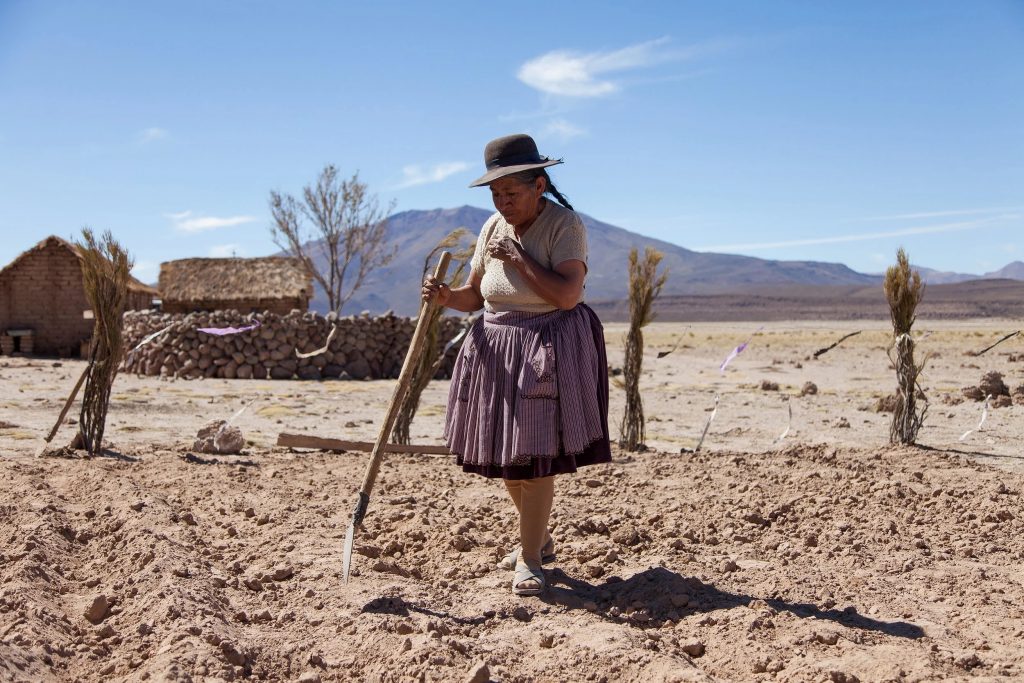
Set in the Bolivian highlands, Our Home follows an elderly Quechan couple whose life is shaped by the rhythms of the desert. The film opens with wide shots of the Bolivian highlands, the sun-cracked soil stretching for miles with llamas grazing and a thin river tracing the edge of the village. The scene is accompanied by what Walid calls a “nearly ominous background score of Bolivian folklore instruments – pan flutes, percussion and lute – [that] lingers as the man treads towards the horizon” (2022). Sisa (Luisa Quispe) reads these climate-driven changes as a call to leave, while Virgino (José Calcina) refuses to leave his home, even with his cough deteriorating, the dying terrain symmetrical with his struggle. This friction peaks as Virgino pauses in his and the other villages’ quest to perform a sacrifice in hope of an end to the drought, and whispers, “You’re dying. You’re dying”. Here the film collapses the boundary between human frailty and ecological collapse, foregrounding how deeply emotional and cultural identities are braided to the land. Utama honours a way of life on the verge of expiry through the devastation of watching that world lose its breath.
The film’s slow pacing and minimal dialogue mirror the land’s own exhaustion, its temporal rhythms stretched thin by drought. Wide shots linger on dry fissures in the ground, on skies so vast they dwarf human intention, and on the absence of water. As climate change intensifies, the landscape becomes a political ultimatum, forcing the Quechan community to choose between ancestral connection and climate-driven displacement, as they say, “If we leave our land, it will be left in silence”. The youth of the community imagine futures shaped by migration, while the elders embody a worldview tied to mutuality with the land. The film’s director, Alejandro Loayza Grisi exposes the injustice of a predicament borne most heavily by those least responsible, calling his film “a love story […] facing the dilemma of saying goodbye to the most beloved’ to ‘touch emotions that are inherent to the human being and common in all cultures” (2022). This ethos of love allows the film to become a memoir-like reflection guided by the complexities of loss. The Altiplano’s drought is intrinsically existential, revealing the loss of land and belonging when a homeland becomes uninhabitable.
The Gasoline Thieves reveals a Mexican a landscape shaped by scarcity and economic desperation, where the terrain itself bears the marks of a nation abandoned by its institutions. The central Mexican fields are sliced open by illegal fuel taps, their ruptured soil revealing not only the physical extraction of gasoline but the deeper extraction of dignity and opportunity. The land becomes an archive of neoliberal neglect, a place where survival requires criminality. Rob Nixon’s notion of ‘slow violence’ underscores that the ‘ecologically dispossessed without being empowered via infrastructure, are ripe for revolt’ (42).
The Gasoline Thieves follows the story of a 14-year-old boy, Lalo (Eduardo Banda), who takes a liking to his classmate, Ana (Regina Reynoso). Wanting to give her a gift, he needs money, leading him to the underworld of gasoline theft. The film’s director, Edgar Nito explores the politics of survival when a worker says, “They say our poor country has a gas shortage, but they just hoard it to sell it later at a higher cost”. When an older huachicolero tells Lalo, “Don’t let them fool you, kid. This is honest work”, the film exposes how the poverty collapses the distinction between legality and integrity, recasting this illegal labour as a form of honour to the rural poor.
When the story comes to a head, as Lalo and Rulo (Pedro Joaquín) fight over Ana, the gasoline taps are left unattended and explode, coating Lalo and Rulo in gasoline. This symbolic eruption externalises the fragility of the world they have stepped into, as the land itself retaliates, exposing the boys’ juvenility against the backdrop of the destructive forces of the illegal economy. The gasoline suddenly becomes a violent, uncontrollable substance where rivalry collides with the adult dangers of greed and desperation. When the spilt gasoline catches fire, flames catch across the field. As Peter Debruge notes, this moment captures, “such a waste, which, of course, is exactly Nito’s point, unforgettably rendered in the film’s final scene”.
Across these three films, the political agency of landscape emerges not as a shared aesthetic but as a set of differentiated interventions shaped by each region’s ecology and material conditions. Birds of Passage mobilises the Guajira desert as a spiritual witness, a terrain that registers the Wayuu’s internal erosion. Our Home, by contrast, transforms the Altiplano into an ecological warning shaped by drought. The Gasoline Thieves depicts central Mexico as a landscape wounded by state abandonment and infrastructural decay. Taken together, these films reveal not a unified model of landscape politics but a spectrum of cinematic strategies through which land becomes a site of conflict, witness, and memory. The films are united in their insistence that the land can never be neutral. Northern Colombia, the Altiplano and central Mexico each become terrains that reveal the pressure shaping contemporary life and the toll this takes on people who live there. These filmmakers suggest that to grasp the realities of contemporary Latin America, one must tend to the land itself.
References
Contreras Vergel, Jazid. ‘Film Review: Oscar‑Nominated Gallego and Guerra Soar with Pájaros de Verano.’ The Bogotá Post.com 5 Aug. 2018. Web. 8 Jun 2026.
de la Cadena, Marisol.Earth Beings: Ecologies of Practice across Andean Worlds. Duke University Press, 2015.
Debruge, Peter. ‘Huachicolero (‘The Gasoline Thieves’) Review.’ Variety.com, 20 June 2019. Web. 8 Jun 2026.
Loayza Grisi, Alejandro. ‘Alejandro Loayza Grisi Interview on Utama at London Film Festival 2022.’ Youtube.com. 20 Mar. 22024.Web. 8 Jun. 2026.
Monani, Salma.Indigenous Ecocinema: Decolonizing Media Environments. West Virginia University Press, 2024.
Nixon, Rob. Slow Violence and the Environmentalism of the Poor. Harvard University Press, 2011.
Walid, Shayeza. ‘Utama Review: Bolivian Highlanders Weather the Climate Crisis.’ BFI.org.uk. 28 Oct. 2022. Web. 8 Jun. 2026.
—
This article may be used free of charge. Permission must be obtained before redistribution. Selling or commercial use without prior written consent is prohibited. Copyright @ 2025 Martha-Mae Dorothea King
Images: Utama press pack, Conic Films; no modification